





















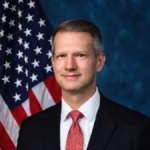






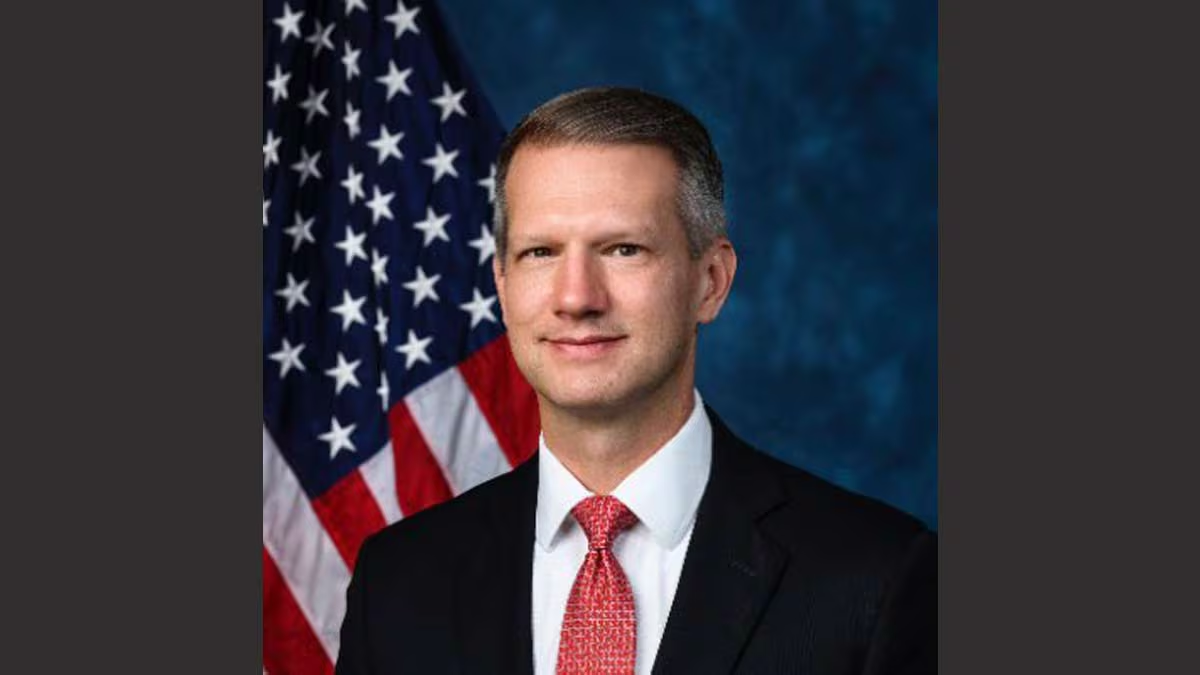
A proposed amendment to India’s Foreign Contribution (Regulation) Act (FCRA) has ignited fresh debates over religious freedom, state control over non-governmental organizations (NGOs), and minority rights, drawing sharp and highly public criticism from a United States lawmaker. West Virginia Republican Congressman Riley Moore has openly slammed the proposed Foreign Contribution (Regulation) Amendment Bill, 2026, describing it as a “clear attack against Christians” and warning that its passage could create significant friction in the bilateral relationship between the United States and India.
The controversy surrounding the bill highlights the delicate balance India must strike between safeguarding its internal security from unregulated foreign funding and maintaining its global image as a pluralistic democracy, especially in the eyes of its strategic Western allies.
Understanding the FCRA Amendment Bill 2026
The Foreign Contribution (Regulation) Act was initially enacted by the Indian Parliament to regulate the acceptance and utilization of foreign contributions by individuals, associations, and companies. The primary stated objective of the law is to ensure that foreign funding does not adversely affect the internal security, sovereignty, or democratic processes of the nation. Over the years, the legislation has undergone several iterations, each generally increasing the compliance burden on NGOs and charities.
The newly proposed 2026 amendment bill seeks to further tighten the state’s control over assets acquired through foreign funding by organizations whose FCRA registrations have lapsed, been voluntarily surrendered, or been officially canceled by the Ministry of Home Affairs.
According to the legislative tracker PRS Legislative Research (PRSIndia), the new bill establishes a comprehensive legal framework for the “supervision, management, and disposal of foreign contributions and assets” belonging to an entity that no longer holds a valid FCRA certificate. To execute this mandate, the bill dictates the creation of a ‘Designated Authority’ appointed by the government.
Crucially, the legislation includes a specific provision regarding religious institutions. If the assets in question involve a place of worship—such as a church, temple, or mosque—the Designated Authority is legally obligated to ensure that its inherent religious character is maintained during its supervision. Furthermore, in a move toward leniency on the penal front, the bill actually reduces the maximum penalty for violations of the Act from five years of imprisonment to one year.
Congressman Riley Moore’s Scathing Critique
Despite the structural clarifications and the inclusion of clauses meant to protect the sanctity of religious sites, Congressman Riley Moore took to the social media platform X (formerly Twitter) to voice severe apprehensions. His critique specifically focused on the potential implications for Christian institutions in India, echoing concerns raised by global religious freedom advocacy groups.
Moore argued that the legislation paves the way for hostile government takeovers of Christian charities, educational institutions, hospitals, and places of worship once their FCRA registrations expire or are denied renewal by the state.
“Christians have been in India since St. Thomas the Apostle traveled to the Malabar Coast just decades after the resurrection of our Lord Jesus Christ,” Moore wrote, highlighting the deep historical and cultural roots of Christianity in the Indian subcontinent. “But despite this long Christian history, India’s Parliament is considering amending Foreign Contribution Regulation Amendment (FCRA) rules to permit government takeovers of churches and religious charities.”
Drawing a direct line between domestic Indian policy and international diplomacy, the Republican congressman issued a stark warning regarding the strategic partnership between Washington and New Delhi. “This is a clear attack against Christians. If this bill proceeds in this way, it would be a point of major concern in our bilateral relationship with India,” he stated categorically.
Reactions from India: A Polarized Domestic Discourse
Congressman Moore’s comments quickly triggered a polarized response from Indian netizens, legal experts, and political commentators, reflecting the deeply divided domestic opinion on foreign funding and the regulation of religious institutions.
Many Indian social media users and right-leaning political commentators pushed back aggressively against Moore’s narrative, defending the Indian government’s sovereign right to regulate the inflow of foreign money. They accused Western politicians of meddling in India’s internal legislative processes. Supreme Court lawyer and prominent author J. Sai Deepak publicly supported the legislation in response to Moore, writing on X, “Thank you for making the case for a stronger FCRA regime. This, right here, is the real Deep State.”
Another Indian user echoed this nationalistic sentiment, arguing that American interference inadvertently validates the legislation: “If USA is openly opposing Indian Govt move to amend FCRA. It surely means Govt of India is doing something right. HOPE THEY DON’T BACK DOWN!!” Other critics pointed out that Moore was misrepresenting the bill by framing it exclusively as an anti-Christian measure, noting that the FCRA applies uniformly to all NGOs, regardless of their religious affiliation.
Conversely, domestic critics of the bill, including various minority rights advocates and civil society leaders, have argued that Moore’s concerns are not entirely unfounded. They fear that the potentially vague criteria for FCRA cancellation could be weaponized by the state to seize valuable properties, schools, and land operated by minority communities under the guise of financial regulatory compliance.
The Broader Context of FCRA Regulations
The controversy over the 2026 amendments is not an isolated incident but rather the latest chapter in a long-running saga concerning foreign funding in India. Over the past decade, the Indian government has progressively tightened FCRA regulations, citing money laundering, forced religious conversions, and anti-national activities as primary justifications.
Consequently, thousands of NGOs—including prominent international human rights bodies like Amnesty International and Greenpeace, alongside numerous Christian and Islamic charities—have lost their FCRA licenses. This ongoing crackdown has frequently drawn the ire of international human rights watchdogs and foreign governments, who argue that the financial laws are being systematically used to stifle civil society, silence government critics, and marginalize minority groups.
Potential Impact on India-US Bilateral Ties
While the US State Department has yet to issue an official, formal statement specifically targeting the 2026 FCRA Amendment Bill, Moore’s vocal opposition highlights the underlying, persistent tensions regarding human rights and religious freedom in the India-US strategic partnership.
The two nations currently share robust economic, military, and technological ties, increasingly viewing each other as crucial and indispensable counterweights to China’s growing influence in the Indo-Pacific region. However, domestic policies in India regarding minority rights, press freedom, and NGO operations continue to be a recurring friction point in US congressional hearings and bilateral dialogues in Washington. If the FCRA Amendment Bill passes in its current form and leads to the seizure of religious assets, it could force the US administration to address the issue more forcefully, potentially complicating diplomatic engagements and trade negotiations in the near future.