




















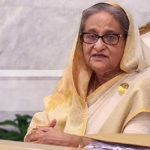



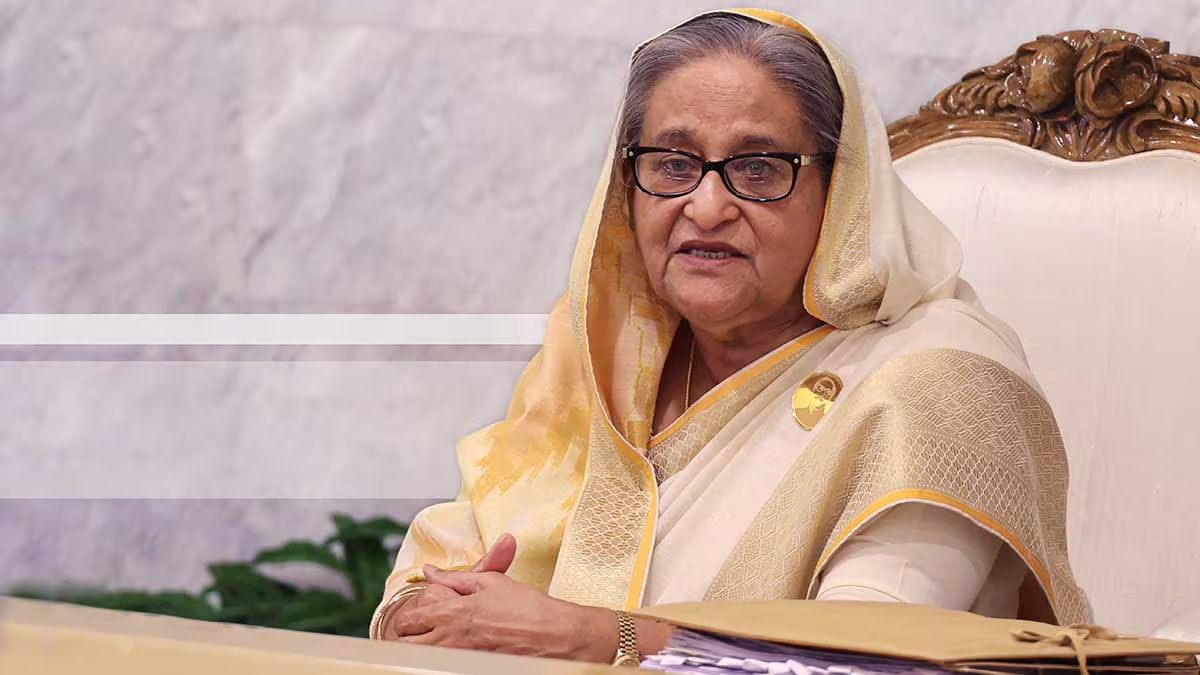
In a development that threatens to strain the evolving diplomatic relationship between New Delhi and Dhaka, the Bangladesh government has officially sought clarification from India regarding an upcoming virtual address by ousted former Prime Minister Sheikh Hasina. Scheduled to speak from her exile in India on August 5, 2026, Hasina’s planned public appearance has triggered strong objections from Bangladesh’s current administration, which has warned that allowing a “fugitive” to conduct political activities on Indian soil could severely undermine bilateral ties.
The diplomatic standoff comes at a sensitive juncture as both nations are actively attempting to recalibrate their relations under the new Bangladeshi leadership of Prime Minister Tarique Rahman. The controversy underscores the lingering shadows of the 2024 political upheaval in Bangladesh and highlights the complex geopolitical tightrope India must walk in South Asia.
The Controversial August 5 Address
The focal point of the current diplomatic row is a private media event organized by the Foreign Correspondents’ Club of South Asia (FCC South Asia) in New Delhi. Billed as Sheikh Hasina’s first major public appearance since she fled Dhaka exactly two years ago, the event is heavily loaded with political symbolism. August 5 marks the second anniversary of the massive, student-led uprising that culminated in the dramatic fall of her government in 2024.
According to widespread reports, the 78-year-old former premier will join the event virtually to share her perspectives and reportedly reveal her plans to return to Bangladesh. The panel is also expected to feature her US-based son, Sajeeb Wazed Joy, former education minister Mohibul Hasan Chowdhury Nowfel, and Bangladesh Human Rights Watch general secretary Mahammad Ali Siddique. For the new administration in Dhaka, a high-profile political platform granted to Hasina in the Indian capital is seen as a direct provocation.
Dhaka’s Firm Stance: “India Must Make Its Position Clear”
The Bangladesh government has not minced words in expressing its displeasure. Shama Obaed Islam, the State Minister for Foreign Affairs, explicitly called on the Indian government to clarify its stance regarding the event. Speaking to reporters at the Ministry of Foreign Affairs in Dhaka, she stressed the need for mutual respect in the bilateral relationship.
“We are moving forward with India with a forward-looking approach,” Shama stated. “We don’t want it to be damaged, and I firmly believe that India doesn’t want it either. So, India has to make clear whether it supports this event or not.”
While acknowledging that the event is being organized by an independent media entity and not the Indian government, Shama pointed out that because Hasina is currently sheltered in India, New Delhi bears a degree of responsibility. Dhaka has repeatedly communicated—both verbally and in writing—that individuals it classifies as convicted fugitives should not be permitted to use Indian territory to launch political campaigns aimed at destabilizing Bangladesh.
High-Level Diplomatic Interventions
The escalating concern in Dhaka prompted immediate diplomatic action. Humaiun Kobir, the Foreign Affairs Adviser to Prime Minister Tarique Rahman, recently held a crucial meeting with Dinesh Trivedi, the newly appointed Indian High Commissioner to Bangladesh, at the Prime Minister’s Office.
During the meeting, Kobir officially relayed Dhaka’s expectations. He emphasized that the Indian government must prevent any individual associated with the banned Awami League, particularly Sheikh Hasina, from utilizing Indian soil to make political statements. Kobir noted that allowing such activities to take place could severely undermine the “positive momentum” that both nations have been trying to build in recent months.
The Indian High Commission in Dhaka described the meeting as cordial, focusing on “increasing people-centric cooperation between the two neighboring countries.” The High Commissioner reportedly assured the Bangladeshi administration that the matter would be duly considered and active attention would be paid to their concerns.
Legal Complexities and Extradition Demands
The friction over the virtual address cannot be viewed in isolation from the broader legal crusade the Bangladesh government has launched against Sheikh Hasina and her erstwhile political apparatus. Following her ouster, the Awami League was disbanded under a stringent anti-terror law by executive order.
Furthermore, Sheikh Hasina is currently facing a multitude of criminal charges in Bangladesh. She was recently sentenced to death in absentia for crimes against humanity, stemming from the brutal and fatal crackdown on the student protesters during the 2024 uprising, which claimed hundreds of lives.
Dhaka has formally requested her extradition from India to face justice within the Bangladeshi legal system. While New Delhi has acknowledged the receipt of the extradition request and stated that it is under legal consideration, the process remains caught in a web of complex international laws and profound political sensitivities. For India, extraditing a long-standing ally poses significant ethical and strategic dilemmas, yet shielding her indefinitely risks alienating the current political establishment in Bangladesh.
India’s Response and the Broader Geopolitical Impact
In response to the mounting pressure, sources within the Indian government have sought to distance New Delhi from the August 5 press conference. The Ministry of External Affairs has reportedly maintained that the government has absolutely no role or involvement in the event, emphasizing that the FCC South Asia is a private organization exercising its independent prerogatives.
However, in the highly charged atmosphere of South Asian geopolitics, optics matter as much as official policy. If Sheikh Hasina succeeds in using the New Delhi platform to rally her disbanded party members and issue statements that provoke unrest in Bangladesh, it could force Dhaka to escalate its diplomatic protests.
This friction arises at an inconvenient time, as both nations are looking toward future engagements. There have been preliminary discussions regarding an invitation for Prime Minister Tarique Rahman to attend the upcoming BRICS Summit in New Delhi scheduled for September 2026. A prolonged dispute over Sheikh Hasina’s political activities could overshadow such multilateral engagements and disrupt vital bilateral trade, security cooperation, and border management initiatives.
Ultimately, the controversy surrounding the August 5 virtual address represents a critical stress test for India-Bangladesh relations. It challenges New Delhi to find a delicate balance between adhering to its democratic principles of free speech for private organizations and respecting the sovereign concerns of a neighboring government demanding justice for past atrocities.