




















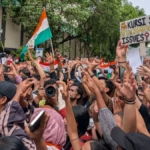



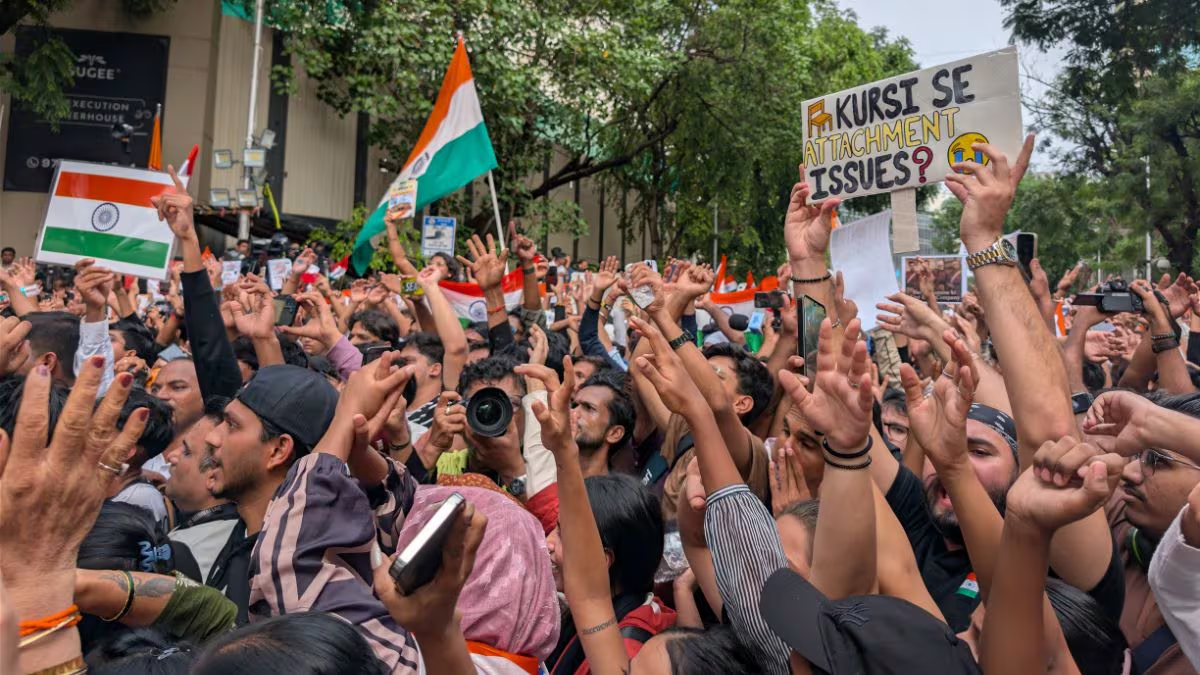
NEW DELHI — In a major legal victory for the thousands of young activists who took to the streets over the past two months, the Supreme Court of India on Monday, August 3, 2026, issued a crucial clarification allowing state governments and the National Capital Territory (NCT) of Delhi to close or withdraw First Information Reports (FIRs) registered against student protesters.
The ruling comes as a massive relief for the youth-led Cockroach Janta Party (CJP) and various student organizations that spearheaded a nationwide agitation against widespread irregularities in the NEET-UG medical entrance examination, the CBSE On-Screen Marking lapses, and repeated paper leaks. The apex court’s clarification effectively clears the path for the government to grant amnesty to students who participated in the demonstrations, provided they are not accused of heinous crimes.
Decoding the ‘Criminal Antecedents’ Clause
The three-judge bench, comprising Chief Justice of India (CJI) Surya Kant, Justice Joymalya Bagchi, and Justice V. Mohana, convened to clarify the nuances of an earlier interim order passed on July 28. In that previous directive, the Supreme Court had barred law enforcement agencies from taking coercive action against protesting students, provided they did not possess any “criminal antecedents.”
However, advocates representing the student groups expressed deep concerns that the term “criminal antecedents” was dangerously ambiguous. They argued before the bench that the police could exploit this vagueness to keep FIRs pending against students for minor, unrelated infractions, such as past traffic violations or participation in previous peaceful demonstrations.
Acknowledging the merit of this argument, the bench explicitly redefined the parameter. “It is clarified for the July 28 order that the NCT of Delhi and any other State shall be at liberty to close or withdraw FIRs against protesters. The word ‘criminal antecedents’ is to be read as grave and heinous offences,” the Court ordered. This ensures that students facing petty charges will not be disqualified from the relief measures, effectively shielding them from long-term damage to their academic and professional careers.
The Government’s Stance and Legal Semantics
During the proceedings, Solicitor General Tushar Mehta, representing the Union government and the Delhi Police, assured the court that the Centre is “serious” about its commitment to granting amnesty to the protesting students. The commitment to drop the charges had been a primary condition negotiated by the CJP and student leaders to call off their protests in late July.
Mehta noted that while the government holds a non-adversarial stance toward the students, the legal architecture requires specific procedural steps to quash an FIR once registered. Justice Joymalya Bagchi stepped in to “enable” this process, pointing out that investigating agencies can file closure reports under Section 193 of the Bharatiya Nagarik Suraksha Sanhita, 2023 (BNSS). Alternatively, public prosecutors are empowered to move applications seeking a formal withdrawal from prosecution in accordance with statutory procedures.
The bench advised the authorities to first categorize the FIRs logged across the states, separating cases involving student protesters from those involving hardened criminals who may have infiltrated the rallies.
The CJP Movement and the NEET Fiasco
The Supreme Court’s ruling is the latest chapter in what has become one of the most unexpected and powerful political movements in recent Indian history. The demonstrations were born out of profound youth frustration following the 2026 NEET-UG paper leak, which jeopardized the futures of nearly two million medical aspirants and tragically led to multiple student suicides.
The protests were uniquely galvanized by the Cockroach Janta Party (CJP), a satirical youth movement founded in May 2026 by digital communications strategist Abhijeet Dipke. The movement’s name was a direct, ironic reclamation of a remark made by CJI Surya Kant in a previous hearing, where he had compared unemployed social media activists to “cockroaches” and “parasites.”
What began as an internet meme rapidly morphed into a massive offline phenomenon. The CJP, joined by prominent left-wing student organizations and climate activist Sonam Wangchuk, occupied Jantar Mantar for over a month. The agitation culminated in the massive ‘Sansad Chalo’ (March to Parliament) on July 20. The intense public pressure eventually resulted in the resignation of Union Education Minister Dharmendra Pradhan on July 25, after which the protests were formally called off.
Tackling Police Brutality and Pellet Guns
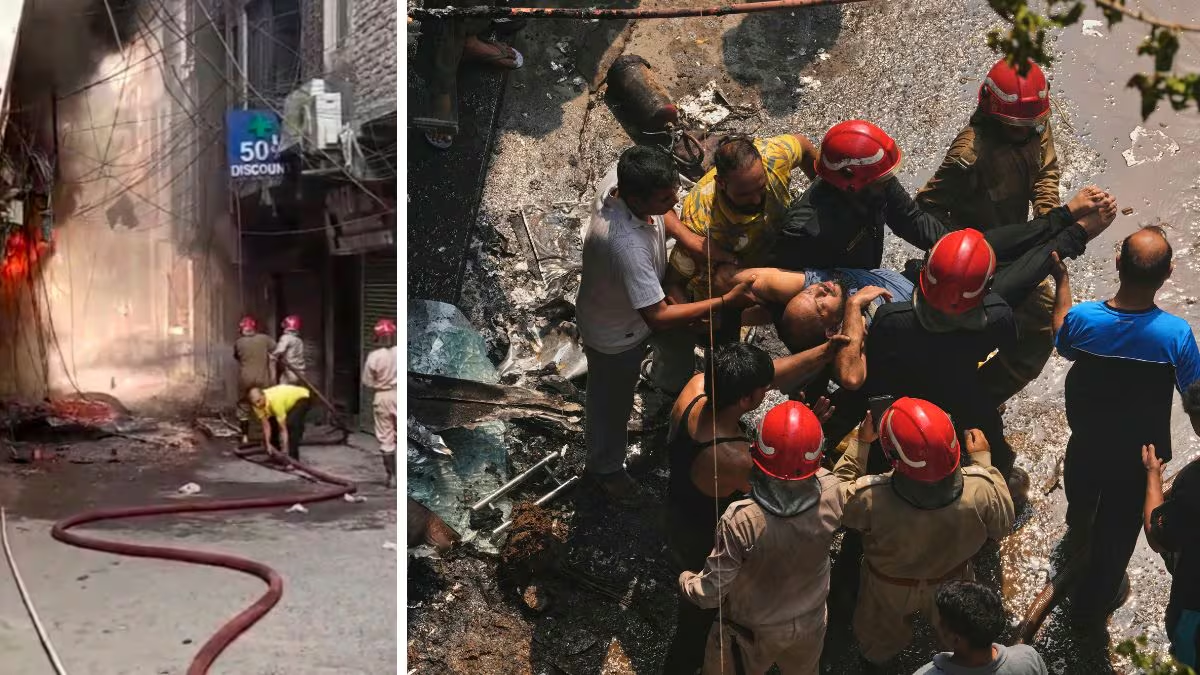
Beyond the withdrawal of FIRs, Monday’s hearing also heavily focused on allegations of severe police brutality during the July 20 Parliament march. Senior advocates, including Vrinda Grover and Gopal Sankaranarayanan, brought forth chilling reports of law enforcement using disproportionate force, including lathis embedded with nails and electric batons.
A significant point of contention was the alleged use of metallic pellet guns against the student protesters, a crowd-control measure that reportedly resulted in severe injuries, including the loss of eyesight for one student. Advocate Grover highlighted that there was no standing order by the Delhi Police mandating the use of pellet guns in the capital.
Taking strict cognizance of these allegations, CJI Surya Kant remarked that the court would establish a comprehensive and uniform protocol governing the use of pellet guns for crowd control across the country. The court stated it would clearly define the extreme circumstances under which such force might be permissible, aiming to prevent future human rights violations during peaceful democratic assemblies.
Looking Ahead
In its concluding remarks, the Supreme Court reiterated its directives for the absolute protection of juvenile protesters, mandating the immediate release of any detained minors. Furthermore, the court has ordered the preservation of all digital evidence—including CCTV footage, drone recordings, and body-worn camera logs—to facilitate an independent probe into the alleged police excesses.
The apex court has scheduled the next hearing for August 18, 2026. Until then, both the Centre and the respective State governments have been directed to file their comprehensive responses and begin the legal groundwork for the withdrawal of the student FIRs.
For the millions of young Indians who supported the movement, the Supreme Court’s clarification is a validating victory—affirming their constitutional right to peaceful protest while safeguarding their futures from the shadow of criminal prosecution.