




























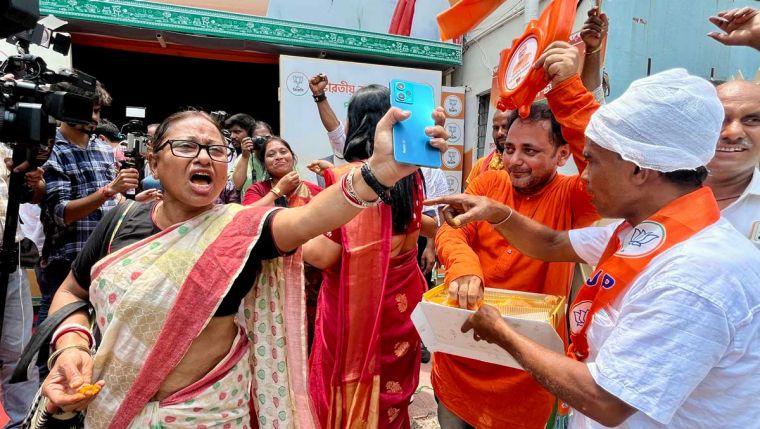
KOLKATA – In a political earthquake that has reshaped the landscape of Eastern India, the Bharatiya Janata Party (BJP) is on the verge of scripting history. As counting progresses for the 2026 West Bengal Assembly Elections, the saffron party has surged past the majority mark, signaling the end of Mamata Banerjee’s decade-plus rule and the beginning of a new era in Bengal politics.
According to the latest data from the Election Commission of India, the BJP is leading in 156 seats, comfortably crossing the magic figure of 148 required to form the government in the 294-member assembly. The incumbent Trinamool Congress (TMC), seeking a fourth consecutive term, has faced a massive setback, leading in only 86 seats—a staggering decline from its previous performances.
A Decisive Mandate and Record Turnout
The 2026 elections will be remembered for more than just the results. The state witnessed unprecedented democratic participation, recording the highest voter turnout since Independence. The two-phase polling held on April 23 and April 29 saw a combined turnout of 92.47%.
Political analysts suggest that such a massive surge in voting often indicates a strong “pro-change” wave. The BJP’s campaign, centered on “Asol Poriborton” (Real Change) and the promise of a “Double Engine Government,” appears to have resonated deeply with an electorate weary of localized corruption and seeking industrial growth.
Key Battlegrounds and Performance
The BJP’s dominance is evident across various geographical belts of the state. The party has maintained a strong lead in its traditional strongholds of North Bengal and the tribal-dominated Junglemahal region. However, the real shock for the TMC came from the industrial belts and urban centers, including Kolkata.
In a symbolic blow to the ruling party, BJP’s Purnima Chakraborty is leading against TMC veteran Shashi Panja in Kolkata. Other crucial leads for the BJP include seats such as Asansol Dakshin, Kharagpur Sadar, Bankura, and Durgapur Purba.
In the high-profile contest of Nandigram, Leader of Opposition Suvendu Adhikari is leading by over 3,100 votes against TMC’s Pabitra Kar. While Chief Minister Mamata Banerjee holds a lead in her Bhabanipur constituency, the collapse of the party elsewhere suggests a disconnect between the leadership and the grassroots.
The “Polarization” Factor and Suvendu Adhikari’s Statement
As the trends became clear, Suvendu Adhikari did not mince words regarding the party’s strategy and the electoral divide. Speaking to the media, Adhikari asserted that the BJP would likely cross the 180-seat mark by the end of the day.
“The BJP is forming the government. All Hindus are united in favor of Narendra Modi,” Adhikari stated, adding a controversial note on the voting patterns by suggesting a sharp divide between “Hindu EVMs” and “Muslim EVMs,” while noting that the Congress had managed to hold ground in specific pockets like Malda and Murshidabad.
His slogan, “Rone dijiye. Khatam poora khatam” (Let them cry. It’s over, completely over), has already gone viral on social media, encapsulating the aggressive stance the BJP took throughout the campaign.
Factors Behind the TMC’s Decline
Several factors contributed to the Trinamool Congress’s apparent downfall:
- Anti-Incumbency: After 15 years in power, the TMC faced significant fatigue among voters.
- Corruption Allegations: Ongoing investigations into various recruitment scams and local-level corruption provided the BJP with potent ammunition.
- Organizational Attrition: The steady exodus of mid-level leaders to the BJP over the last two years weakened the TMC’s once-impenetrable booth-level management.
- Consolidation of Opposition Votes: With the Left-Congress alliance failing to regain its former glory, the anti-TMC vote consolidated almost entirely behind the BJP.
The Road Ahead: Challenges for the BJP
While the celebrations have begun at the BJP headquarters in Kolkata, the task ahead is monumental. Governing West Bengal—a state with a complex socio-political fabric and significant debt—will require a transition from “agitation mode” to “administration mode.”
The BJP’s first priority will be to address the law and order situation, which often becomes volatile during power transitions in Bengal. Furthermore, the party will need to deliver on its promises of massive industrialization to provide jobs for the state’s youth, a demographic that largely tilted toward the saffron camp in this election.